IGA Day Excursion
The Hot and Cold of Killiney Geology!
Leaders: John Walsh and Sam Kelley
Meet: at Killiney DART station at 10.05 am on Saturday Sept 19th 2026
Duration: 3-4 hours
Sam Kelley:
Sam joined the UCD School of Earth Sciences in 2019 as an Assistant Professor in Quaternary Geology. Previously he had graduated in Geology from Dalhousie University, with an MSc in Quaternary and Climate Studies from the University of Maine, and a PhD from the State University of New York at Buffalo. He is a glacial geologist with an interest in the connections between earth surface processes, ice sheets and glaciers, and changes in climate.
John Walsh:
John Walsh is Professor of Structural Geology at University College Dublin and Founding Director (2014-2018) and Co-PI of the Irish Centre for Research in Applied Geosciences (iCRAG). His research interests are on all aspects of the formation and growth of faults and fractures, and their impact on subsurface fluid flow and hazards within a variety of application areas. He also enjoys going out in the field to look at rocks!
Where will we go?
https://maps.app.goo.gl/zGGN4WvejyqkPWQs5 – Killiney DART station
https://maps.app.goo.gl/VFfTTdS3hhtuaBWU8 – Killiney beach car park
https://maps.app.goo.gl/TVKaseprxMn1R3oL8 – Killiney beach toilets
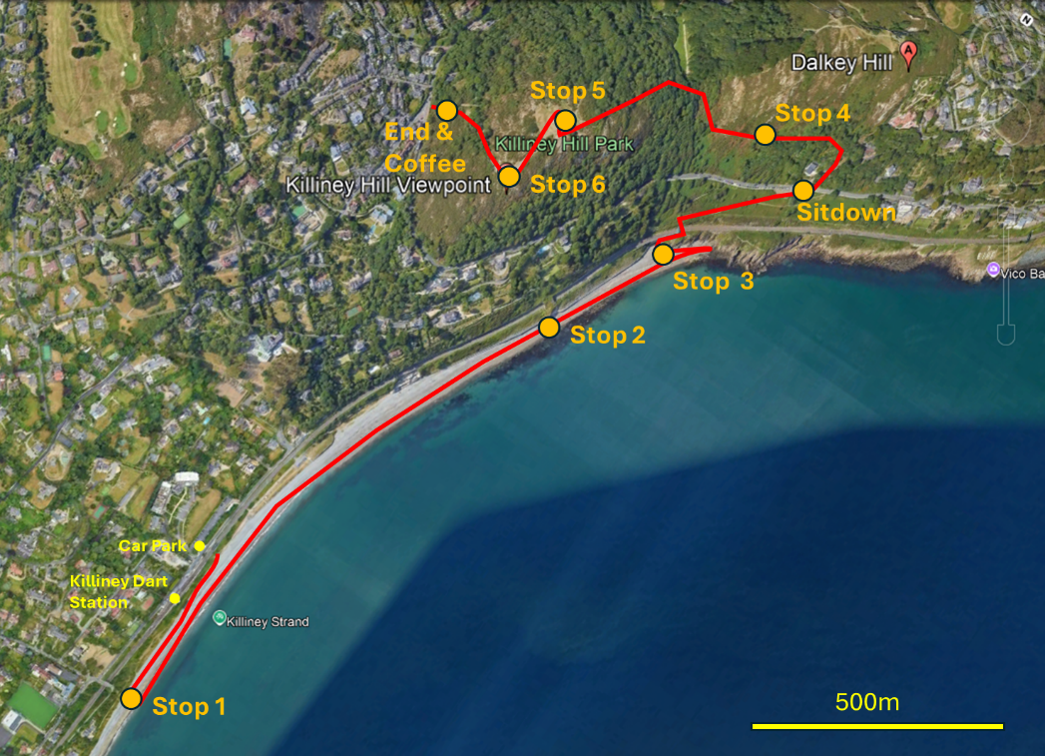
The plan is to meet at Killiney DART station at 10.05am (to coincide with DART times) and then walk along the beach looking at hard rocks and glacial sediments. This will be followed by a walk from the beach to the top of Killiney Hill (150m). The latter is along a good path, but in places it can become a stiff walk up steps. We will, however, take our time and should be fine for those in walking shape (the general itinerary is shown in the graphic on the following page). The hard rock side of things will involve looking at the contact of the Leinster Granite, including a variety of granites together with associated contact and regional metamorphic rocks. We’ll examine evidence for the nature and timing of granite intrusion (ca 405My old) relative to the Caledonian Orogeny. The glacial geology of the Killiney area is complex, recording the initial growth of the ice sheet from Scotland at the start of the last glacial period, as well as shifts in ice flow as the British-Irish Ice Sheet grew and later receded. During the peak of the last glaciation, an ice stream occupied the current Irish Sea, acting as a major conduit for ice flow to the south and into the Celtic Sea. As we’ll see, the glacial sediments backing Killiney Beach have been modified by glacio-tectonic processes, resulting in features commonly seen within faulted or tectonised rocks, such as faults and folds.
Please register HERE